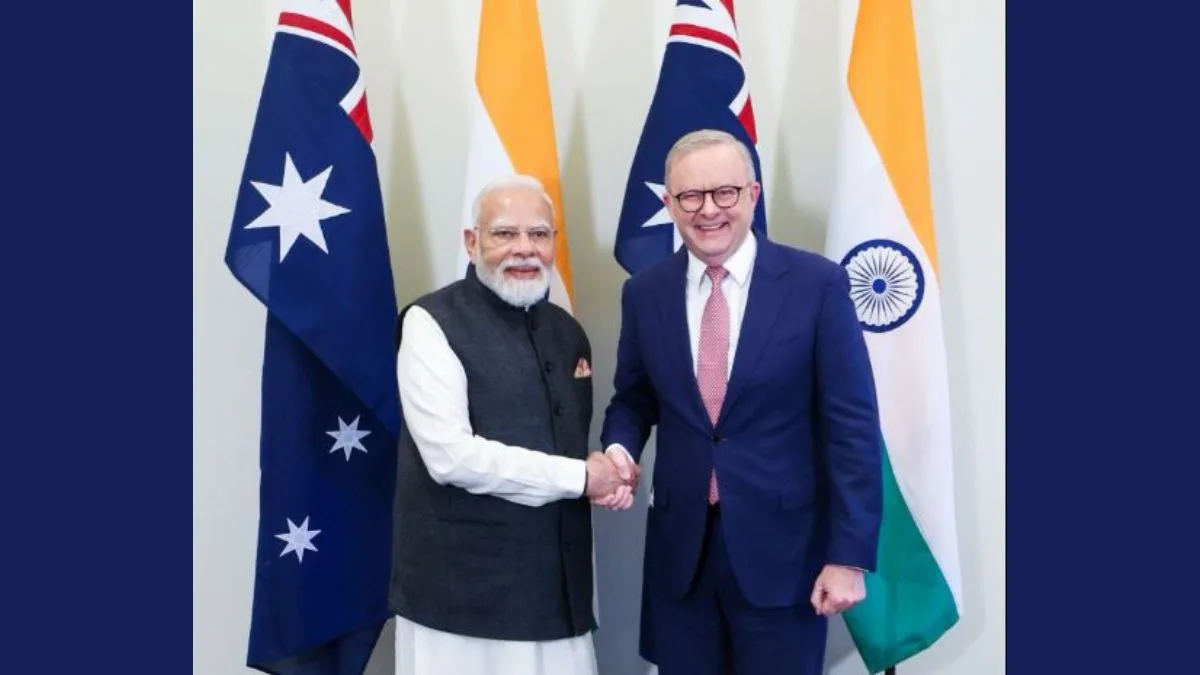
Highlighting the growing economic partnership between India and Australia, Prime Minister Narendra Modi on Thursday said the two nations are “natural and trusted partners” amid global uncertainty.
Speaking to business leaders from both countries at the Economic Roadmap Business Reception during the India-Australia CEO Forum, Prime Minister Modi urged them to deepen collaboration across sectors such as clean energy, infrastructure, artificial intelligence and education, IANS reported.
Advertisement
“Today, the world is going through a period of uncertainty, supply chain disruptions, and an energy crisis. At such a time, it is both natural and necessary for India and Australia to move forward as natural and trusted partners,” Prime Minister Modi said.
He added, “Over the past few years, we have built a strong framework for future cooperation by combining the capabilities of both countries.”
The Prime Minister noted that the India-Australia Economic Cooperation and Trade Agreement (ECTA), which concluded in record time in 2022, has significantly strengthened bilateral economic ties between the two nations and created fresh opportunities for businesses.
“Since its implementation, exports from India to Australia have doubled, and businesses in both countries have benefited from new market access; however, we have not stopped there — we are now moving towards a Comprehensive Economic Cooperation Agreement,” he said.
He added, “Through these efforts, the governments of both nations have prepared a new runway, and the aircraft of investment and innovation is now ready to take off. You all have to take this to new heights.”
Talking about the opportunities in the clean energy sector, Prime Minister Modi said India is rapidly building a robust manufacturing ecosystem for hydroelectric projects and green hydrogen.
“We are building a manufacturing ecosystem in India for hydro projects, green hydrogen, solar modules, and windmills,” he said.
He further highlighted that New Delhi has set the targets of achieving 500 gigawatts of renewable energy capacity by 2030 as well as Net Zero emissions by 2070. He said Australia’s technological expertise, financial resources and natural reserves could play a crucial role in accelerating India’s energy transition.
“A few months ago, India opened up the nuclear sector to private companies. We have set a target of 100 gigawatts of nuclear energy by 2047. Australia’s vast uranium reserves are directly linked to India’s nuclear journey,” he said.
Invited Australian investors to participate in India’s expanding infrastructure sector, Prime Minister Modi said there are vast opportunities in ports, airports, highways, railways and urban development projects.
“There are immense possibilities for Australian long-term investors in India’s port, airport, road, railway, and urban infrastructure sectors. Today, national highways in India are expanding at a pace of approximately 34 kilometres per day. More than 8 kilometres of railway tracks are being laid daily. This represents a convergence of scale, speed, and stability,” he said.
“The Indian government has provided support exceeding $10 billion under the AI Mission, Quantum Mission, and Semiconductor Program. We can collaborate to develop global solutions in the fields of data centres, AI, quantum technology, semiconductors, and digital public infrastructure,” he added.